Showing posts with label Russian. Show all posts

April 7, 2008

April 7 | Alexander Bogdanov

August 22, 1873, - April 7, 1928: Age 54

Alexander Bogdanov was a Russian physician and polymath who wrote science fiction books, philosophized, wrote about economics, and believed that blood transfusions could extend life and rejuvenate health.

His experiments seemed so successful that, upon Lenin's death, he was commissioned to resuscitate his body, however he was unsuccessful. He wrote, however, to Stalin of his dreams of rejunvenating the Boshevik party leadership.

In March of 1928, a group of students volunteered to take part in blood exchanges to help them study more energetically for exams. L. I. Koldomasiv, who had inactive tuberculosis and malaria, was ruled out for medical reasons, but Bogdanov contacted him and proposed a mutual blood exchange, with the idea that as a middle-aged doctor he would be immune to tuberculosis. Both hoped that Bogdanov's immunity could be transferred. They exchanged nearly one litre of blood.

Both had reactions; Koldomasov survived and his lung lesions cleared. He was reportedly still alive in 1983 at age 76. Bogdanov had chills and fever, intestinal distress, hemolysis and oliguria, then jaundice. He died on 7 April 1928.

Sources: Wikipedia, Science Fiction Studies (review 1987), The Struggle for Viability

March 18, 2008

March 18 | Ivan Grozny

August 25, 1530 – March 18, 1584: Age 53

In the immortal words of Malcolm Forbes, "Ivan the Terrible was as bad as he sounds." But that, of course is not the whole story.

Ivan was the first Russian monarch to rule as Tsar. He expanded and united the Russian kingdom and made many essential reformations, including the creation of sea ports and initiation of a trading relationship with England. This while fighting scheming aristocrats within his own kingdom who had no notion of a "Russia" that extended beyond the needs of their own immediate enrichment.

Ivan was called "Grozny", which means "terrible" in the sense of "terrifying" or "fearsome", because he had all the qualities necessary for the job: he was ruthless, suspicious, stubborn, and cruel. The first half of his reign went pretty well, but nearly dying in 1553 and the death of his wife his personality became more and more extreme. Some examples:
  • When he had St. Basil's Cathedral constructed in Moscow, he was so moved by its beauty that he had the architects blinded so that they could never design anything as beautiful again
  • He formed a secret police, the Oprichniks, who owed allegiance only to him and became a bunch of murderous thugs
  • He ordered the Oprichniks to murder all the inhabitants of Novgorod; the exact death toll is unknown but estimates are they succeeded in killing about 30% of the population
  • He beat his daughter-in-law for wearing immodest clothing, causing a miscarriage
  • In a fit of rage at his son he clubbed him with a staff, accidentally killing him
This last deed was imagined and painted 300 years later by the great Repin, and the picture above is a detail from that. Ivan inspired many artists; he was a towering figure, a villain of such proportions that I find myself wishing Shakespeare had known more about him.

In 1584, a comet was spotted, and Ivan called together 60 astrologers to interpret the vision. They agreed that it was a sign he would die soon. Soon, Ivan's body became swollen from unknown causes. He seemed to recover, then on March 18, while playing chess with the statesman Bogdan Belsky, he suddenly collapsed and died.

In the 1960s his tomb was opened during renovations, and an examination of his remains revealed very high amounts of mercury. He was probably poisoned; the presence of mercury would explain his symptoms and, to some extent, his madness. Three days before his death he tried to rape his daughter-in-law, who was the sister of Boris Godunov, future tsar and star of Pushkin's play and Mussorgsky's opera. Modern suspicion falls on Godunov as his probably assassin.

We do, luckily, have Sergei Eisenstein's vision of him. During WWII, with morale in Russia low, Stalin (who admired Ivan) ordered the filmmaker to create a film of Ivan's life. The result is one of the greatest films of the era: It was filmed in three parts. The first part was released in 1944. The second part offended Stalin, as its depictions of Ivan's paranoia were a little too close to the mark. It was not released until after Stalin's death. The third part was seized and mostly destroyed.

Ivan Grozny himself is played brilliantly by Nikolai Cherkasov, marvellously creepy and impressive. But it is impossible to communicate anything about the film by talking about one performance, or one part. The whole structure, the costumes, all the performances, the sets, everything works together as a whole to create an unforgettable experience.

Here is an excerpt that dramatizes his struggle with Philip, a church patriarch who openly opposed him. The scene imagines the moment where he decided to become "the Terrible" as he was known by his enemies. This excerpt has French subtitles, but even if you can't read French (or understand Russian) the power of the film is palpable.

Sources: Wikipedia; Forbes, Malcolm, They Went That-a-Way, Simon and Shuster, New York, 1988.

February 27, 2008

February 27 | Alexander Borodin

November 12, 1833 - February 27, 1887: Age 53

Alexander Borodin was a chemist, but also a musician and composer, one of "The Five" or "The Mighty Handful", top-notch composers dedicated to producing distinctively Russian art music in the 19th century (the other four were Mussorgsky, Rimsky-Korsakov, Cui, and Balakirev).

As a chemist Borodin was quite famous and respected; his work took up much of his time and he composed as a hobby, for pleasure and companionship with fellow musicians. His musical output was small, but excellent: three symphonies, three string quartets, an opera (finished by Rimsky-Korsakov), and a handful of piano music, songs, and other bits and pieces.

There are some famous tunes in Polovetsian Dances, scored for the opera Prince Igor. That's because Robert Wright and George Forrest adapted Borodin's works for the musical Kismet. Borodin is credited as the main composer and even got a Tony Award for this show in 1954, more than 60 years after his death. Ironically when Kismet premiered in 1953 there was a newspaper strike which allowed it to become a hit by word of mouth; when the papers reappeared the reviews were bad and might have caused the show to flop. One critic panned the show as "a lot of borrowed din". Someone should have written a bad review of his pun.

In 1887 he had already had heart trouble, as well as a bout with cholera. He attended a fancy dress ball wearing a nationalist costume — a red shirt and high boots — and joined in the dancing with vigour and high spirits. At midnight, he fell back, and died within a few seconds of heart failure.

Do listen to the lovely recording of the first movement of his string quartet No. 2, played by the quartet of the La Scala orchestra. It's been filmed very well, with (gratifyingly to me as a string player) care in the editing to ensure that cutaways to the musician's hands and arms match what is actually being played. Once you watch this all kinds of related links come up with other groups performing movements from same piece; all disappointingly bad, unfortunately. But for some good fun, check out the Polovetsian Dances in the excerpt of the 1969 movie Prince Igor on YouTube... Listen for, and enjoy, the tune used for "Stranger in Paradise".

Sources: Wikipedia, Biography of classical composer Alexander Borodin

February 10, 2008

February 10 | Alexander Pushkin

June 6, 1799 - February 10, 1837: Age 37

Pushkin published his first poem at the age of 14, and by the time he finished high school he was widely known to be among the greatest Russian literary figures. He moved in the highest and most avant-garde circles in St. Petersburg, soaking in the vibrant atmosphere of social reform and becoming a key literary radical. He annoyed the government sufficiently to be "transferred" out of the capital and into the sticks, where the bureaucrats hoped he would become obscure.

Far from sinking into obscurity, Pushkin joined a number of secret societies and wrote a couple of poems that brought him international acclaim. The government responded by exiling him still further into the sticks, this time to his mother's rural estate in northern Russia. He lobbied successfully with the Tsar himself for his release, and returned to St. Petersburg, but soon found himself under suspicion again as copies of his poems kept turning up amongst the papers of rebels and other intellectual troublemakers.

Now strictly censored, he wrote one of his greatest works, Boris Godunov, a powerful drama about the Russian ruler who took power from 1598 to 1605, but riffing dangerously on themes of corruption and regicide. It took him five years to get it published, and then only in a heavily censored form. The play was not performed in its uncensored form until 2007, 182 years after it was written.

It is interesting that this stubborn and difficult man, treated with utmost suspicion by the government, was known to the Tsar and in fact admitted to court life. Tsar Nicholas I was no intellectual and in fact one of the most reactionary rulers in Russian history. It was a strange time: Russian society was experiencing an intense flowering of artistic and intellectual creativity at the same time as the Russian government was at its most repressive.

In 1831 he married a renowned beauty from a wealthy family of manufacturers. They became regulars in court circles. The Tsar gave Pushkin the lowest court title, and Pushkin (perhaps rightly) assumed that this was so that his wife could be ogled by her many admirers at court balls. The cost of living in society was very high, and he fell into debt. Moreover, among his wife's admirers was her sister's dashing and handsome fiancé, a French nobleman named Georges d'Anthès. Rumours of a scandalous liaison enraged Pushkin, and an anonymous letter circulated in society nominating him "Deputy Grand Master and Historiograph of the Order of Cuckolds" pushed him beyond the brink. He wrote an insulting, non-anonymous letter to d'Anthès' father and, when urged to withdraw his remarks, he challenged d'Anthès to a duel.

Dueling was illegal in Russia at the time but in fact a fairly common occurrence: Pushkin had already dueled several times. One party would demand "satisfaction" from the other, then both parties would select trusted "seconds" (assistants) and a "field of honour" (a place where they could get on with it uninterrupted). Many details would have to be negotiated: time and place, the distance apart from one another, the weapons chosen, who would fire the first shot, and when the duel would be considered finished.

Pushkin and d'Anthès dueled with pistols, and d'Anthès fired first. He hit Pushkin, wounding him in the stomach. Pushkin struggled to his feet and managed to get a shot off at d'Anthès, wounding him lightly on the right arm. Two days later, Pushkin died of his wound; d'Anthès of course did not, but he was arrested briefly, then pardoned (considering the gravity of Pushkin's abuses), stripped of rank, and escorted to the border. He returned to France with his wife and embarked on a successful political career, living to a ripe old age of 83.

Sources: Wikipedia, Alesandr Pushkin

January 23, 2008

January 23 | Anna Pavlova

February 12, 1881 - January 23, 1931: Age 50

Anna Pavlova was arguably the greatest dancer of her time. "Arguably" only because she was a contemporary of Nijinsky and Duncan, both also contenders. But where Nijinsky favoured the avant-garde and Duncan invented her own unique style of dance, Pavlova stuck with the classics.

She trained in Russia under the greatest teachers of the day, and rose quickly to become a soloist in the Imperial Ballet. She went on to form her own company and tour the world, becoming indisputably the world's first ballet superstar. Her most famous role was that of the Dying Swan, choreographed to Saint-Saëns' "The Swan". Although she hated film as an art form, regarding it as toxic to all "true" art, she did allow herself to be filmed dancing this famous role, and today you can see it here, on YouTube.

While touring in the Netherlands her train had a slight accident, derailing and being delayed for 12 hours. She went outside dressed only in pyjamas and a light scarf to see what was happening. As a result of this she caught a cold, which developed into pneumonia. She died three weeks later. At the end, she asked to hold her Dying Swan costume. Her last words were, "Play that last measure very softly."

Sources: Wikipedia, New York Times

December 30, 2007

December 30 | Grigori Rasputin

January 22, 1869 – December 30, 1916: Age 47

Rasputin was a Russian mystic who had a considerable following among the nobility of early 20th century Russia. After an unexceptional childhood, he spent a few months in a monastery, married, and had three children. In 1901 he made a pilgrimage to various places, including Greece and Jerusalem. By 1903 he had arrived in St. Petersburg, where he began to develop a reputation for healing and prophesy. In 1905, he was in Siberia when he got word that the son of the Tsar, who was hemophilic, was bleeding after a fall from a horse. Rasputin was able to provide some relief through prayer and practical advice like "Don't let the doctors bother him too much, let him rest."

Every time the boy had an injury, the boy's mother called on Rasputin, and he got better. She came to believe that God spoke to her through Rasputin, and his influence over the royal household grew.

A group of Russian nobles, viewing this influence as too great a threat, invited Rasputin to dinner and served him cakes and red wine laced with cyanide. Although they put enough poison to kill many men in the food, Rasputin appeared unaffected. One of the assassins, panicking, pulled out a gun and shot him in the back. Then they ran out of the palace, leaving the body alone.

It was a cold night, however, so one came back to get a coat, and he leaned over to check on the body. Rasputin opened his eyes, grabbed him by the throat, whispered “You bad boy” in his ear, threw him across the room, and tried to run away. The other assassins, however, had returned, and they shot him three more times. He fell down but still wasn’t dead, so they hit him until he stopped moving, wrapped his body in a sheet and threw it in the freezing river.

When he body was recovered and autopsied it was found he had still been alive when thrown in the river: he either drowned or died of hypothermia.

No conversation of Rasputin can be complete without this: turn up the volume and click here.

Sources: Wikipedia

December 1, 2007

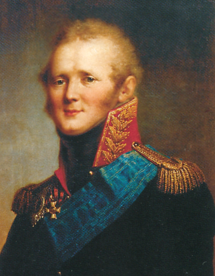
December 1 | Alexander I

December 23, 1777 - December 1?, 1825: Age 47?

Alexander was the grandson of Catherine the Great (see November 17). She had no faith in his father, her son Paul, so she took Alexander from him soon after he was born. His childhood was characterized by the battle between his grandmother and his father and, like certain children under such circumstances, he withdrew into himself, presenting to the outside world whatever personality and views seemed to suit whomever he was dealing with.

Catherine died in 1796. Paul I succeeded her and tried to put through a number of reforms that were met with hostility and conflict. He was murdered in 1801, less than five years after his ascension, and Alexander became Tsar at the age of 23. It seems likely that Alexander knew of the plots against his father, but it is not known whether he was actually implicated in his father's murder.

His reign was difficult. The balance of power in Europe was constantly shifting, and in 1812 he had to deal with the invasion of Napoleon. Reform was desperately needed, but bitterly opposed by many factions. He tried to put through many of the same kinds of reforms his father did, but gradually, as he became older, he began to reverse them, and became suspicious of the people around him. It was not unfounded; at least one attempt was made to kidnap him. In the autumn of 1825 he became ill while traveling and died of typhus on December 1. His wife died a few months later.

His death came as a great surprise. There was confusion around the succession, as he had no living legitimate children. His brother Constantine had renounced the succession some years earlier but that had not been announced publicly. In the end, another younger brother, Nicholas, succeeded him as Nicholas I.

There were rumours that he had really faked his death and funeral, and that he was living incognito as a monk or in some foreign land. A hermit named Feodor Kuzmich emerged, travelling around Russia doing good works for people, and speaking and acting in a mysteriously aristocratic fashion. Many people, even today, believe that Feodor Kuzmich was in fact Alexander I, who had chosen this strange way to renounce his throne and expiate the sin of patricide. People believed that an unknown soldier had been buried in Alexander's place. So persistent was this rumour that the Soviets opened his tomb in 1925, 100 years after his death. Inside they found nothing. The tomb was empty. Nobody knows why.

Sources: Wikipedia, Imperial Legend

November 22, 2007

November 23 | Alexander Litvinenko

August 30, 1962 - November 23, 2006: Age 44

Anyone who believed that Russia's social and political troubles might end with the collapse of the Soviet Union has been disillusioned many times over since 1990. The death of Alexander Litvinenko last year was particularly troubling. Litvinenko was a KGB officer who had been moved into a high position in their Military Counter Intelligence department. He, along with a number of peers, spoke out publicly against the corruption and dirty dealing in the department and in the Russian government, right up to the top, including links to organised crime. He was arrested, then released, and managed to escape the Soviet Union on a false passport, his wife and son travelling out legally through Turkey. They sought and received asylum and citizenship in the United Kingdom.

Litvinenko tried to publish a book in Russia outlining Putin's rise to power as a staged campaign that included fake bombings blamed on Chechnyan rebels being used as an excuse to bring military force into Chechnya. A common enemy, whether an external state or a terrorist group, has the effect of uniting people behind a perceived strong leader.

On November 1, 2006 Litvinenko met with some Russian businessmen, then later with an Italian KGB expert. Later that day he began to feel unwell, and by November 4 was admitted to hospital. By November 19 doctors confirmed that he had been poisoned with some kind of radioactive material, although at first they were unable to accurately identify what.

Meanwhile Litvinenko's condition deteriorated very rapidly. He knew, of course, that he had been poisoned, and spoke out very frankly to journalists about it. The photograph at right was taken less than three weeks after he fell ill, and just a few days before his death. His kidneys were damaged, he was vomiting almost constantly and had lost all his hair. His bone marrow was severely damaged and he had almost no white blood cells left. By November 20 the hospital confirmed that he was in ”serious but stable“ condition, under armed guard, was struggling to speak and had only a 50 percent chance of survival. His family was taken into protective custody.

Meanwhile a media storm was in process, with public accusations against the Russian government and matching denials. The Italian associate he met on November 1 announced that he had received threats on his life just before the meeting. The exact cause of the poisoning was still unknown. On November 22 Litvinenko suffered a heart attack during the night, and on November 23 he died.

By January 2007 British police had determined the exact poison (polonium-210, a highly unstable isotope) and knew a great deal about how it was brought in to the country and administered (in a cup of tea). In May 2007 they charged Andrei Lugovoi, one of the businessmen Litvinenko met with on November 1, with his murder. Lugovoi lives free in Russia and extradition requests have been denied.

The case is extremely complex but there are plenty of sources to read more about it. I will give the last word to Litvinenko himself, who issued a deathbed statement on the case.

I would like to thank many people. My doctors, nurses and hospital staff who are doing all they can for me, the British police who are pursuing my case with vigour and professionalism and are watching over me and my family. I would like to thank the British government for taking me under their care. I am honoured to be a British citizen.

I would like to thank the British public for their messages of support and for the interest they have shown in my plight.

I thank my wife Marina, who has stood by me. My love for her and our son knows no bounds.

But as I lie here I can distinctly hear the beating of wings of the angel of death. I may be able to give him the slip but I have to say my legs do not run as fast as I would like. I think, therefore, that this may be the time to say one or two things to the person responsible for my present condition.

You may succeed in silencing me but that silence comes at a price. You have shown yourself to be as barbaric and ruthless as your most hostile critics have claimed.

You have shown yourself to have no respect for life, liberty or any civilised value.

You have shown yourself to be unworthy of your office, to be unworthy of the trust of civilised men and women.

You may succeed in silencing one man but the howl of protest from around the world will reverberate, Mr Putin, in your ears for the rest of your life. May God forgive you for what you have done, not only to me but to beloved Russia and its people.


Sources: Wikipedia, The Litvinenko Justice Foundation, Axis News, ABC News

November 17, 2007

November 17 | Catherine the Great

May 2, 1729 - November 17, 1796: Age 67

Catherine the Great was a German princess who married the heir to the Russian throne. In time, her husband ascended the throne as Tsar Peter III.

Catherine was a brilliant woman in many respects, but above all a brilliant politician. Her husband, on the other hand, was not, and in 1762 she initiated a bloodless coup. He was sent to retire in comfort on a country estate, but was killed soon after by conspirators fearing his return to power.

Although she was not Russian her son, Paul, was the legitimate heir, and she was accepted by the Russian people as their ruler. Catherine ruled Russia pretty much unchallenged for the remaining 34 years of her life. During that time she ruled competently, mediated foreign disputes, corresponded with the greatest minds of the era, took countless lovers, and brought Russia into closer alignment with the principles of the Enlightenment.

On November 16, 1796 she woke up in the morning, had her morning coffee, dismissed her lover and went into her bathroom. When she didn't come out for half an hour, her attendants called for her secretary. When his knock didn't get an answer, he went in, and found her unconscious on the floor. Doctors tried to revive her by bleeding her and raising blisters on her feet, but to no avail. She died the next evening.

Sources: Wikipedia; Forbes, Malcolm, They Went That-a-Way, Simon and Schuster, 1988.

November 6, 2007

November 6 | Pyotr Ilyich Tchaikovsky

May 7, 1840 - November 6, 1893: Age 53

Tchaikovsky was arguably the greatest Russian composer of all time, and one of the greatest composers in history. Whether or not you realize it, you are probably quite familiar with many of his melodies: famous themes from ballets like Swan Lake, the Nutcracker, and Sleeping Beauty, for example, or the incredible finale of his 1812 Overture (the one that features live cannons). Going deeper into his oeuvre — symphonies, concerti, operas, and other pieces — many of his themes are instantly recognizable.

He was a hero of Russia. When news of his death reached the Tsar, he immediately offered to pay for the funeral. 60,000 people applied for tickets to Tchaikovsky's funeral (capacity was only 8,000) and many more lined the streets of St. Petersburg to pay respects to the procession.

But Tchaikovsky was a gay man living in a society that hated homosexuals. Tchaikovsky himself struggled with his orientation, attempting a marriage and then trying to kill himself by jumping into the cold Moscow River two weeks after the wedding. The marriage ended in six weeks.

The official cause of Tchaikovsky's death was cholera. There were outbreaks all over Russia at the time, and people were warned to boil their water before drinking it or even washing with it. According to reports, he asked for a glass of water in a restaurant and, informed they had no boiled water available, requested it unboiled. Two weeks later he was dead.

Even at the time there were doubts: a number of people noticed that his illness, treatment, and the handling of his body did not quite match the putative cause. In the 1970s a very different account was published, a story that had been kept secret for 80 years. According to this account, he was threatened by a secret "court of honour" with terrible reprisals, and was advised to kill himself as punishment for his homosexuality. Apparently he had fallen in love with his nephew, and the network of school alumni felt that any exposure would result in disgrace for the whole school. Here is biographer David Brown's version:

"The incident took place in the autumn of 1893. Tchaikovsky was threatened with terrible misfortune. Duke Stenbok-Fermor, disturbed by the attention which the composer was paying to his young nephew, wrote a letter of accusation to the Tsar and handed the letter to Jacobi. Through exposure Tchaikovsky was threatened with the loss of all his rights, with exile to Siberia, with inevitable disgrace. Exposure would also bring disgrace upon the School of Jurisprudence and upon all the old boys of the school, Tchaikovsky's fellow students. To avoid publicity Jacobi decided upon the following. He invited all Tchaikovsky's former schoolmates [he could trace in St. Petersburg], and set up a court of honour which included himself. Altogether there were eight people present. Elizveta Karlovna sat with her needlework in her usual place alongside her husband's study. From time to time from within she could hear voices, sometimes loud and agitated, sometimes dropping apparently to a whisper. This went on for a very long time, almost five hours. Then Tchaikovsky came headlong out of the study. He was almost running, he was unsteady, and he went out without saying a word. He was very white and agitated. All the others stayed a long time in the study talking quietly. When they had gone Jacobi told his wife, having made her swear absolute silence, what they had decided about the Stenbok-Fermor letter to the Tsar. Jacobi could not withhold it. And so the old boys [of the school] had come to a decision by which Tchaikovsky had promised to kill himself. A day or two later news of the composer's mortal illness was circulating in St. Petersburg."


As it happens his symptoms match arsenic poisoning much more closely than cholera. The day after the "glass of water" his brother found him in bed suffering from diarrhea and stomach pains. Tchaikovsky refused to call a doctor, and tried to carry on with his day, taking cod liver oil in an attempt to ease his stomach. Within days he was much worse, and a doctor diagnosed him with cholera. The mortality rate for cholera at that time was more than 40%, but he seemed to get better, then he would get worse again with more pains and cramps. Eventually his kidneys failed, a priest was called, and he died at 3am on November 6, 1893.

The movie, V for Vendetta, used the finale to the 1812 Overture to great effect. The Adagio from the Sixth Symphony is one of the most beautiful pieces of romantic music ever written: enjoy a rehearsal of it here.

Sources: Wikipedia article on Tchaikovsky, Wikipedia article on his death, Brown, David, Tchaikovsky: The Man and His Music (New York: Pegasus Books, 2007)

November 3, 2007

November 3 | Laika

1954? - November 3, 1957: Age 3?

Laika was a stray dog found wandering in the street in Moscow. She was one of several dogs chosen and trained to be part of Soviet attempts to send a living being into space.

In the 1950s and 1960s one of the results the mutual hostility between the USSR and USA (the Cold War) was a passionate competition to be first into space. The Soviet Union got an early start with Sputnik in October 1957: the first successful launch and orbit of a satellite in space. The event shocked the USA inspired the world. Eager to follow up this early success with another "first", Russian leader Kruschev ordered that a second satellite be launched to coincide with the anniversary of the Bolshevik Revolution just one month later. The second satellite, Sputnik 2, was to carry a dog in order to measure the effects of space travel on a living being. Sputnik 2 was rushed into production.

Laika is in fact the name of a group of Russian husky breeds; Laika herself was a mongrel (husky and terrier, probably) and called various nicknames by her human friends: Kudryavka (Russian for Little Curly), Zhuchka (Little Bug) and Limonchik (Little Lemon). Three dogs were trained for the flight, and their training included long confinement progressively smaller cages, centrifuges, and a diet of high-nutrition gel. Laika was chosen for the mission and placed into the capsule three days prior to launch. Her bodily functions were to be carefully monitored. Just before liftoff, she was carefully groomed. It was the last living contact she would experience.

During launch itself, her heart rate more than doubled and her respiration tripled. After launch the nose cone separated successfully but another section of the rocket did not, and this prevented the heating system from operating correctly. Her pulse rate did not return to normal for three hours after launch, showing how much stress she was under. She was agitated but eating her food. However her life signs disappeared in a few hours. She probably died from stress and overheating.

The Russians had never planned to retrieve Laika from space; the idea was to euthanize her with a poisoned serving of food once her experiments were over. For years some of them insisted that this is how she died; other Russians stated that she had suffocated. The truth of her death was not made public until 2002, and in the excitement of the "success" of the mission it seemed as though few humans cared. There were a few protests in the West, virtually none in Russia. In 1998, more than 40 years later, the scientist to chose and trained Laika publicly expressed regret for his actions: "The more time passes, the more I'm sorry about it. We shouldn't have done it... We did not learn enough from this mission to justify the death of the dog."

Click here to read the original article in the New York Times reporting on Sputnik 2, reproduced in a 2002 article. Click here to read about all the space dogs and their fates.

Sources: Wikipedia, New York Times

Note: Yes, today I have reported two deaths (see also Olympe de Gouge). That is because for some reason yesterday I started thinking about Laika, and decided to find out her death date in order to write about her. After completing the entry on de Gouge, I looked up Laika and was surprised to see that her death date is today! Having already published a good post on de Gouge I decided to simply add another entry for Laika. Given de Gouge's passionate defence of the oppressed and vulnerable, I believe she would have approved.