August 30, 1962 - November 23, 2006: Age 44
Anyone who believed that Russia's social and political troubles might end with the collapse of the Soviet Union has been disillusioned many times over since 1990. The death of Alexander Litvinenko last year was particularly troubling. Litvinenko was a KGB officer who had been moved into a high position in their Military Counter Intelligence department. He, along with a number of peers, spoke out publicly against the corruption and dirty dealing in the department and in the Russian government, right up to the top, including links to organised crime. He was arrested, then released, and managed to escape the Soviet Union on a false passport, his wife and son travelling out legally through Turkey. They sought and received asylum and citizenship in the United Kingdom.
Litvinenko tried to publish a book in Russia outlining Putin's rise to power as a staged campaign that included fake bombings blamed on Chechnyan rebels being used as an excuse to bring military force into Chechnya. A common enemy, whether an external state or a terrorist group, has the effect of uniting people behind a perceived strong leader.
On November 1, 2006 Litvinenko met with some Russian businessmen, then later with an Italian KGB expert. Later that day he began to feel unwell, and by November 4 was admitted to hospital. By November 19 doctors confirmed that he had been poisoned with some kind of radioactive material, although at first they were unable to accurately identify what.
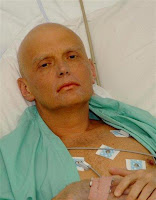
Meanwhile Litvinenko's condition deteriorated very rapidly. He knew, of course, that he had been poisoned, and spoke out very frankly to journalists about it. The photograph at right was taken less than three weeks after he fell ill, and just a few days before his death. His kidneys were damaged, he was vomiting almost constantly and had lost all his hair. His bone marrow was severely damaged and he had almost no white blood cells left. By November 20 the hospital confirmed that he was in ”serious but stable“ condition, under armed guard, was struggling to speak and had only a 50 percent chance of survival. His family was taken into protective custody.
Meanwhile a media storm was in process, with public accusations against the Russian government and matching denials. The Italian associate he met on November 1 announced that he had received threats on his life just before the meeting. The exact cause of the poisoning was still unknown. On November 22 Litvinenko suffered a heart attack during the night, and on November 23 he died.
By January 2007 British police had determined the exact poison (polonium-210, a highly unstable isotope) and knew a great deal about how it was brought in to the country and administered (in a cup of tea). In May 2007 they charged Andrei Lugovoi, one of the businessmen Litvinenko met with on November 1, with his murder. Lugovoi lives free in Russia and extradition requests have been denied.
The case is extremely complex but there are plenty of sources to read more about it. I will give the last word to Litvinenko himself, who issued a deathbed statement on the case.
I would like to thank many people. My doctors, nurses and hospital staff who are doing all they can for me, the British police who are pursuing my case with vigour and professionalism and are watching over me and my family. I would like to thank the British government for taking me under their care. I am honoured to be a British citizen.
I would like to thank the British public for their messages of support and for the interest they have shown in my plight.
I thank my wife Marina, who has stood by me. My love for her and our son knows no bounds.
But as I lie here I can distinctly hear the beating of wings of the angel of death. I may be able to give him the slip but I have to say my legs do not run as fast as I would like. I think, therefore, that this may be the time to say one or two things to the person responsible for my present condition.
You may succeed in silencing me but that silence comes at a price. You have shown yourself to be as barbaric and ruthless as your most hostile critics have claimed.
You have shown yourself to have no respect for life, liberty or any civilised value.
You have shown yourself to be unworthy of your office, to be unworthy of the trust of civilised men and women.
You may succeed in silencing one man but the howl of protest from around the world will reverberate, Mr Putin, in your ears for the rest of your life. May God forgive you for what you have done, not only to me but to beloved Russia and its people.
Sources:
Wikipedia,
The Litvinenko Justice Foundation,
Axis News,
ABC News
 Violette Szabo was an Allied secret agent in France during the Second World War. She was born in Paris, her mother being French and her father English. When she was 19, she met and married a French soldier of Hungarian descent, who was killed in battle shortly after the birth of their daughter in 1942.


